Applications
3D Printing for Hydronics: In-House or Service?
Jigs, fixtures and prototypes for hydronic components: when an in-house printer pays off, and when a 3D printing service with DfAM support does.
For jigs, fixtures and prototypes of hydronic components, the choice is not only which technology to use but also who prints: an in-house department with its own machine, or an outside service. In short: an in-house printer pays off when the work is steady and one process is enough; a service pays off when you need several technologies and materials, volumes are irregular or nobody can look after the machine. This guide explains how to weigh the two routes on your own parts. It is not a case study: it describes how this kind of problem is tackled with additive manufacturing.
Why hydronics needs so much tooling
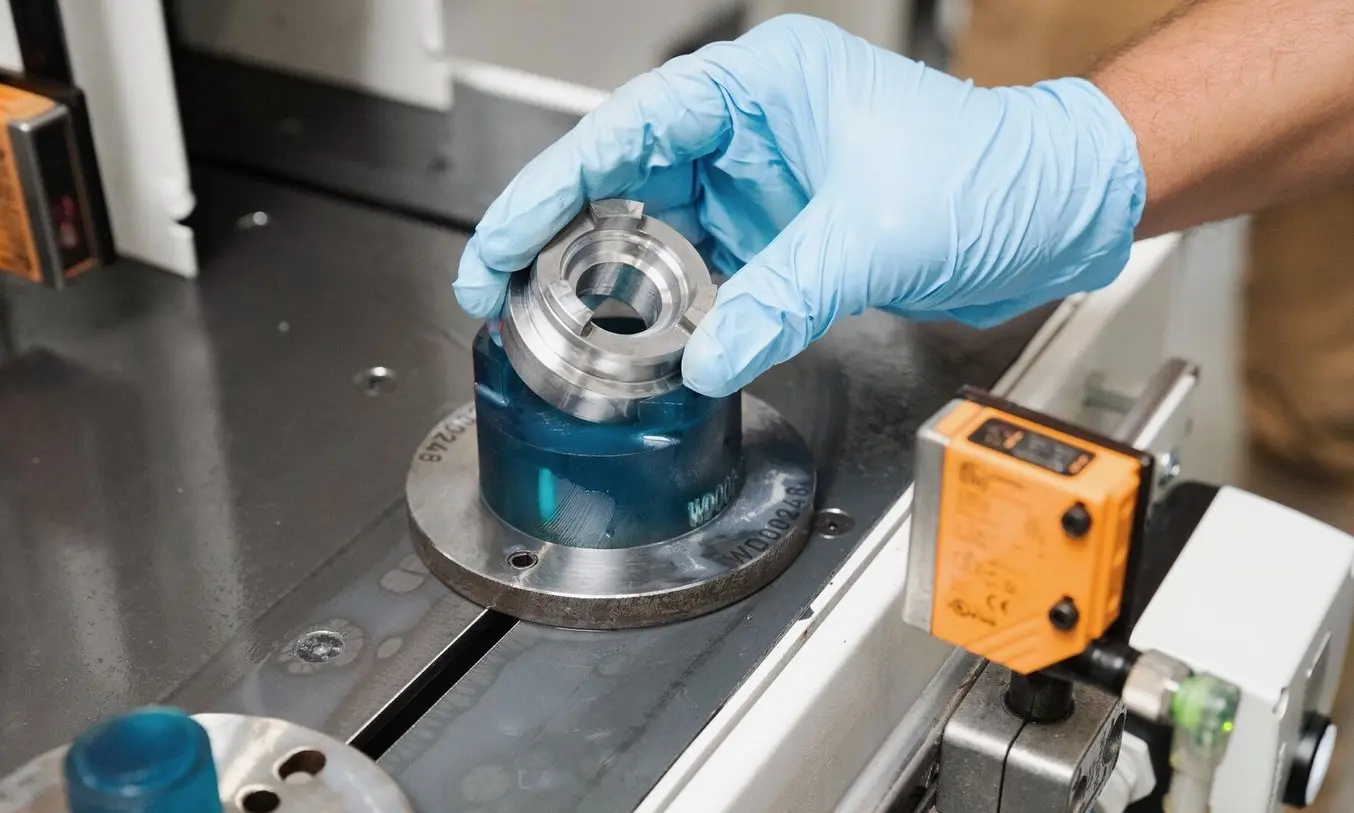
Valves, manifolds, fittings and control units combine complex internal geometries and tight fluid-dynamic tolerances, and they have to hold pressure. In assembly and testing, that means custom jigs, fixtures and masks for every product family, updated with every variant.
With CNC machining, every tool goes through CAM programming, machine setup and machining: fixed costs that weigh most on one-off parts. 3D printing avoids them, because it starts from the CAD with no tooling.
3D printing in-house: what it takes
A printer on the shop floor gives you immediate iterations and full control of your files. In return it needs:
- Space and equipment: a powder machine also needs depowdering stations and a controlled environment; a filament machine for high-performance polymers needs a heated chamber and material drying.
- People: someone has to prepare the jobs, tend the machine and maintain it, with hours taken from process engineering.
- A single process: each machine covers one technology and one family of materials. If one tool calls for continuous fiber and the next for a high-definition resin, the in-house machine serves only one of them.
- Fixed costs: depreciation, maintenance, spare parts and materials stay on the books in the months when the machine does little work.
3D printing as a service: what changes
With a service you pay for the part, not the machine:
- Several technologies, one point of contact: the process is chosen for the part, not for what happens to be on the shop floor.
- DfAM consulting: the component is redesigned for additive manufacturing (assembly consolidation, lightweighting, internal channels) instead of copying the machined part.
- No fixed costs: no depreciation and no dedicated staff, and volumes can go up and down.
The limits have to be counted too: quoting and shipping come on top of the print time, and your files leave the company, so you need a non-disclosure agreement.
Which technology for which tool
| Application | Technology | Material | Why |
|---|---|---|---|
| Assembly jigs | FDM | Carbon-fiber nylon (PA-CF) | Stiffness, fatigue resistance |
| Test fixtures | SLS | Nylon PA12 | Isotropy, functional detail |
| Inspection masks | MSLA | Engineering resin | Fine detail, smooth surfaces |
| Tools exposed to heat | FDM | PPS / Ultem | Stability at high temperature |
| Tools under load | CFC | Nylon with continuous fiber | High stiffness along the fiber, low weight |
The full selection criteria are in the guide to 3D printed jigs and fixtures.
How to decide: five questions
- How many tools do you need in a year, and how regularly? A steady flow justifies a machine; peaks and pauses do not.
- Is one process enough? If you need different technologies and materials, one machine does not cover them.
- Who looks after the machine? Without a dedicated person, an in-house printer sits idle.
- How much does lead time matter? If every hour counts, the machine on the shop floor wins; if a few days are fine, a service is enough.
- Has the part been redesigned for additive? Without DfAM, 3D printing copies the machined part and loses consolidation and lightweighting, whichever route you take.
The two routes can also be combined: a filament printer on the shop floor for simple tools, and a service for powders, resins, continuous fiber, high-performance polymers and metal.
How EptaPrint can help
EptaPrint is an industrial 3D printing service in Brescia, Italy. For tooling and prototypes of hydronic components it offers:
- six technologies through one point of contact: FDM, MSLA, SLS, MJF, continuous fiber (CFC) and metal;
- a free first DfAM review, included in every quote;
- three delivery tiers, in working days: Express in 1–2 when the material is available, Standard in 5–7, Economy from 10; for MJF and metal the lead time is stated in the quote;
- an automatic NDA when you upload your file.
Is a machined tool costing you weeks of waiting? Upload your CAD through the quote form: we reply within 1 working day. If there is no file, we rebuild it from the sample with our reverse engineering and CAD modeling service.